
Complete IT Solutions!

Computer & Hardware Upgrades Melbourne South-East

Computer & Hardware Upgrades in Melbourne’s South-East

Make Your Computer Faster, More Capable and More Useful

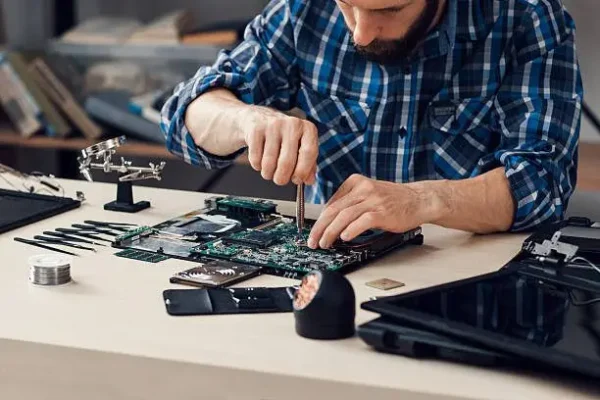
Laptop Repair

Computer Upgrades That Start With Finding the Right Solution

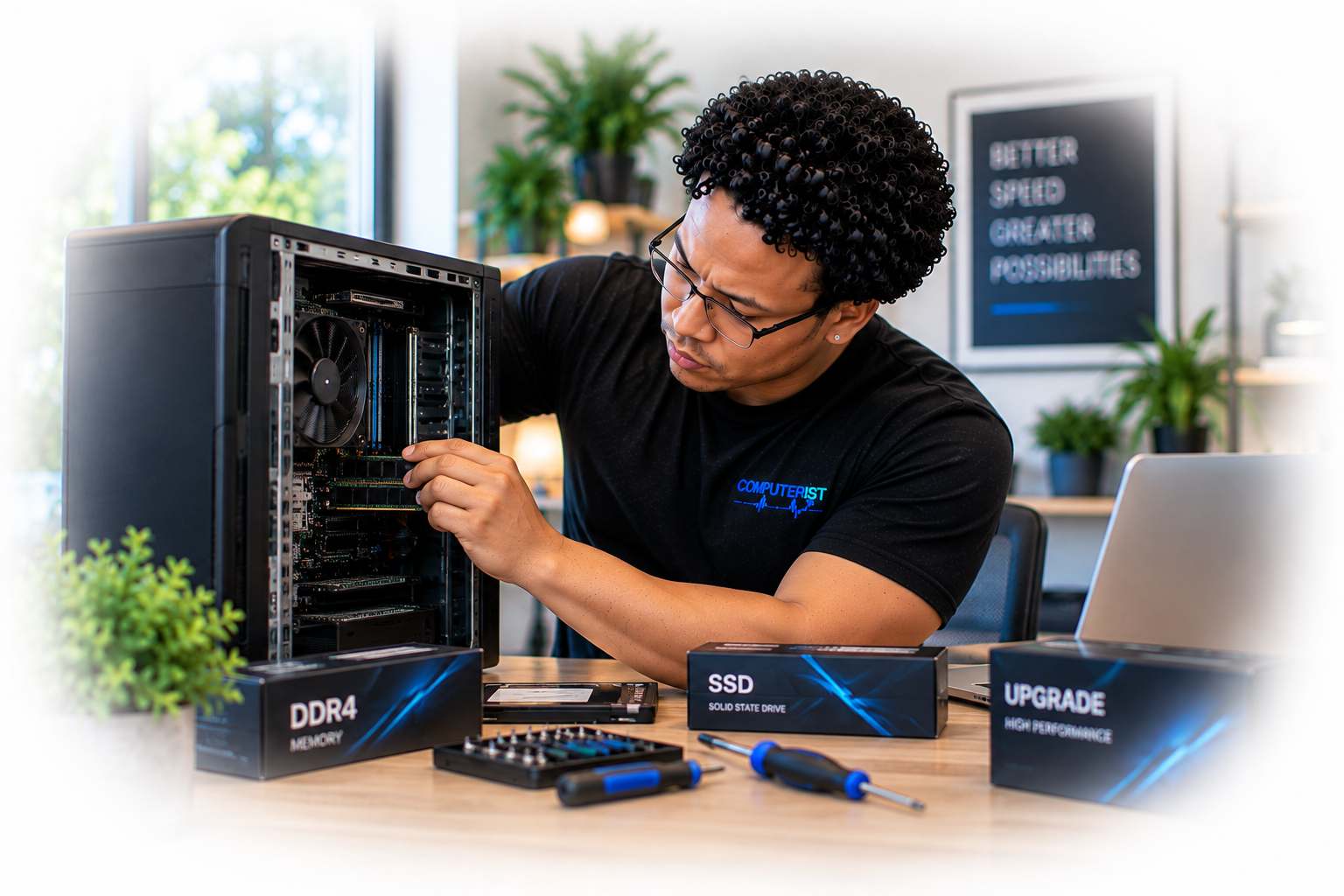
Computer UpgradesA computer upgrade should solve a real problem, not simply add new hardware. Computerist can assess your computer, identify what is limiting its performance and recommend practical upgrades based on what you actually need. Sometimes an SSD or memory upgrade is enough. Sometimes a larger hardware upgrade makes sense. And sometimes replacing the computer is the better option.


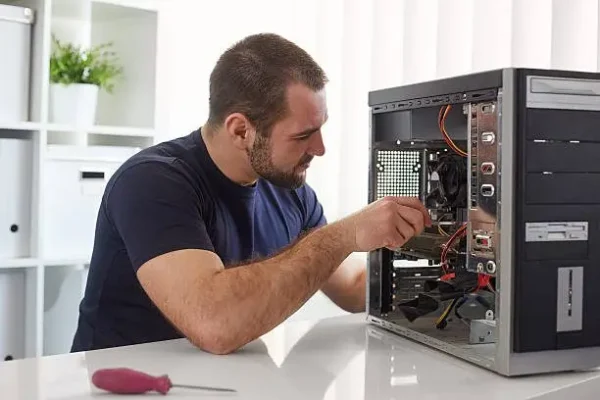
Your computer doesn’t have to be replaced just because it has become slow or no longer does everything you need. In many cases, the right hardware upgrade can give an existing computer significantly more useful life. Computerist provides computer and hardware upgrade services for desktops, laptops and compatible systems across Melbourne’s south-east. Whether you need more storage, additional memory, a faster SSD, better graphics performance or simply want to understand whether upgrading your existing computer is worthwhile, we’ll assess the hardware and explain your options.

Is Your Computer Getting Too Slow?

A computer can gradually become less capable as your requirements change.

Perhaps:

Windows takes too long to start

Applications take ages to open

You constantly run out of storage

Your computer struggles with multiple applications

Games no longer run well

Photo or video editing has become frustrating

Your laptop feels sluggish

You need more space for files

Your business applications are becoming demanding

The obvious solution might seem to be buying a new computer.

But sometimes an upgrade is all you need.

Not Every Upgrade Works With Every Computer

Before recommending an upgrade, we check compatibility, available expansion options, power requirements, physical space, existing hardware and the overall condition of the computer. An upgrade that looks good on paper isn’t useful if the rest of the system can’t support it.

Repair, Upgrade or Replace?

This is one of the most useful questions we can help you answer.

Repair

If your existing computer has a fault, repairing the failed component may be the best option.

Upgrade

If the computer is fundamentally suitable for what you need, upgrading selected components may improve its performance and extend its useful life.

Replace

If the hardware has reached its practical limits, replacement may make more sense.

We don’t upgrade computers simply because we can.

We’ll consider the computer’s age, condition, compatibility, intended use and upgrade cost before recommending anything.

The objective is to make the right investment, not the biggest one.

SSD Upgrades

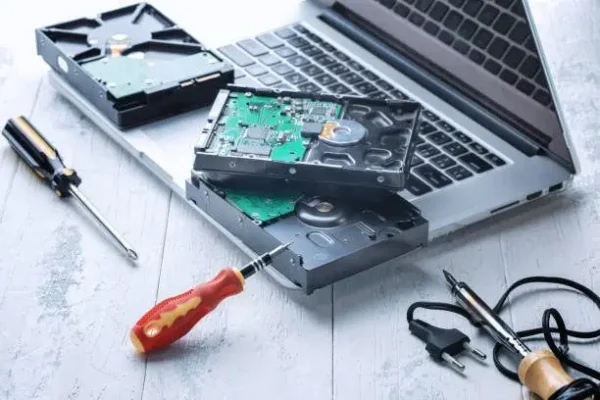
One of the most noticeable upgrades for many older computers is moving from a traditional mechanical hard drive to a suitable SSD.

An SSD can significantly improve everyday responsiveness, particularly when the existing computer is still using an ageing mechanical drive.

Potential improvements include:

Faster Windows startup

Faster application loading

Quicker file access

Better general responsiveness

Reduced waiting

Improved everyday productivity

But an SSD isn’t automatically compatible with every computer.

We need to determine:

Existing drive type

Interface

Physical format

Motherboard compatibility

Available connections

Operating-system requirements

Data migration requirements

We’ll check the system before recommending a particular drive. Microsoft explains the differences between SSD and HDD storage and how storage type can affect PC performance. See Microsoft Support — All about SSD, HDD and storage types

RAM & Memory Upgrades

Insufficient memory can make a computer feel sluggish, particularly when you’re running multiple applications at once.

You may notice:

Applications becoming slow

Excessive disk activity

Browser tabs becoming difficult to manage

Programs freezing

Poor multitasking performance

A RAM upgrade can help where the computer supports additional or higher-capacity memory.

Before upgrading, we’ll check:

Current RAM

Maximum supported memory

RAM generation

Module configuration

Available slots

Operating-system limitations

Compatibility

Adding memory simply because “more RAM is better” isn’t always the answer.

The right amount depends on how you use the computer.

Laptop Upgrades

Laptop upgrade options vary significantly between models.

Some laptops provide accessible memory and storage.

Others have components that are soldered or otherwise integrated into the motherboard.

Before recommending an upgrade, we’ll determine what your laptop actually allows.

Possible upgrade options may include:

SSD

Storage

RAM

Battery

Other compatible components

If an upgrade isn’t practical for your particular model, we’ll explain why rather than selling you something that won’t solve the problem.

Desktop PC Upgrades

Desktop computers generally provide more upgrade flexibility than laptops.

Depending on the system, we may be able to upgrade:

SSD

Hard drive

RAM

Graphics card

CPU

Cooling

Power supply

Additional storage

Expansion cards

Network hardware

The important thing is compatibility.

A faster component isn’t necessarily useful if another part of the system becomes the bottleneck.

Graphics Card Upgrades

A graphics card upgrade can be worthwhile for computers used for:

Gaming

Video editing

3D applications

Graphic design

CAD

Rendering

Certain AI and compute workloads

Multiple high-resolution displays

But installing a more powerful GPU isn’t as simple as choosing the most expensive card that fits inside the case.

We need to consider:

Power supply capacity

Physical dimensions

PCIe compatibility

CPU limitations

Cooling

Case airflow

Monitor requirements

Intended applications

The goal is a balanced system.

A powerful graphics card paired with an unsuitable CPU, inadequate power supply or poor cooling may not deliver the improvement you expect.

CPU Upgrades

Some desktop computers can benefit from a processor upgrade.

However, CPU upgrades are highly dependent on:

Motherboard

Socket

Chipset

BIOS/firmware

Cooling

Power requirements

Existing CPU

Operating system

Sometimes replacing the CPU is worthwhile.

Sometimes the motherboard and processor should be upgraded together.

And sometimes the existing system simply isn’t worth investing in.

We’ll help determine which situation you’re dealing with.

Storage Upgrades

Running out of storage is frustrating.

It can also affect how comfortably you can use your computer.

We can help assess options such as:

Larger SSD

Additional SSD

Secondary hard drive

External storage

Storage for backups

Additional business storage

The correct approach depends on whether you’re looking for:

More capacity

or:

Better performance

or:

Both.

Hard Drive to SSD Migration

If your existing computer uses a mechanical hard drive, moving to an SSD can provide a substantial improvement in responsiveness.

Where appropriate, we can consider migrating your existing Windows installation and data rather than starting from scratch.

The process needs to account for:

Existing storage condition

Data

Operating system

Partition layout

Application configuration

Boot configuration

Drive capacity

If the existing drive is failing, however, data protection becomes more important than simply cloning it.

Computer Upgrades & Data Migration

An upgrade often involves moving information from one storage device to another.

For example:

Old HDD → New SSD

or:

Smaller SSD → Larger SSD

Data migration may involve:

Windows

Applications

Documents 

Photos

User profiles

Browser data

Business files

Configuration

The appropriate migration method depends on the condition and configuration of the existing system.

If important data is involved, we consider backup and recovery before beginning the migration.

Graphics & Gaming PC Upgrades

Gaming computers often benefit from carefully selected upgrades rather than replacing the entire system.

Depending on the computer, improvements may come from:

Graphics card

SSD

RAM

CPU

Cooling

Power supply

But gaming performance isn’t determined by one component alone.

We’ll consider the system as a whole and help identify where the biggest limitation actually is.

Computer Upgrades for Creative Professionals

Photographers, video editors, designers and other creative professionals often place substantially greater demands on their hardware.

Depending on your workload, useful improvements may include:

More RAM

Faster storage

Larger storage capacity

Graphics performance

CPU performance

Better cooling

Additional displays

The correct upgrade depends heavily on the software you use and the type of work you perform.

We’ll focus on the actual workload rather than simply recommending high-end components.

Computer Upgrades for Business

A business doesn’t always need to replace an entire fleet of computers when performance starts declining.

Depending on the hardware and business requirements, targeted upgrades may extend the useful life of existing devices.

Potential improvements can include:

SSD upgrades

RAM

Storage capacity

Network hardware

Display connectivity

Other compatible components

For businesses managing multiple devices, we can also help assess whether upgrading or replacing equipment makes better financial and operational sense.

Can You Upgrade an Old Computer?

Sometimes an older computer can be surprisingly capable after the right upgrade.

For example, a machine with:

An older CPU

Mechanical hard drive

Limited RAM

may feel dramatically better after a suitable SSD and memory upgrade.

But age isn’t the only consideration.

We also need to consider:

Hardware compatibility

Operating-system support

Component availability

Overall condition

Power consumption

Future requirements

Total upgrade cost

There is a point where upgrading stops making financial sense.

We’ll tell you when you’ve reached it.

When an Upgrade Isn’t Worth It

We won’t recommend an upgrade simply because technically it is possible.

Replacement may be more sensible when:

Multiple major components are failing

The motherboard severely limits upgrades

Required parts are difficult to obtain

The computer cannot meet modern requirements

Upgrade costs approach replacement cost

The system is unsuitable for your intended workload

Sometimes the best advice is:

Don’t spend more money on this computer.

That’s useful advice too.

Computer Compatibility Assessment

Before purchasing hardware, compatibility should be checked.

Depending on the upgrade, we may need to consider:

Motherboard

What components does it support?

CPU

Is the processor compatible with the motherboard?

RAM

What type and capacity does the system support?

Storage 

Does the system support SATA, NVMe or another interface?

Power supply

Can it safely provide the required power?

Cooling

Can the system handle the additional heat?

Physical space

Will the new component physically fit?

Operating system

Will the operating system support the new hardware?

Existing bottlenecks

Will the upgrade actually improve the part of the system causing the problem?

Don’t Buy the Wrong Hardware

Hardware specifications can be confusing.

A product may look impressive on a retailer’s website but still be inappropriate for your computer.

Before purchasing an upgrade, we can help you determine:

What you currently have

What your computer supports

What you actually need

What will provide a meaningful improvement

Whether the upgrade is worth the cost

This can prevent an expensive mistake.

Upgrade or Replace?

Not every older computer needs to be replaced. We consider the age and condition of the system, current performance, hardware compatibility, upgrade options and likely cost before recommending what to do. Sometimes a targeted upgrade can extend the useful life of a computer. Sometimes replacement makes more sense. We’ll explain the difference rather than pushing you towards unnecessary hardware.

What Happens During a Computer Upgrade?

1. Tell us what you want to achieve

For example:

I want my computer to start faster.

or:

I need more storage.

or:

My games aren’t running well anymore.”

You don’t need to know which component needs replacing.

2. We assess your computer

We’ll look at the existing hardware and configuration.

3. We identify the bottleneck

The slowest component isn’t necessarily the component you should upgrade.

4. We explain your options

We’ll explain what could be upgraded and what improvement you can realistically expect.

5. You decide

You can choose whether to proceed.

6. We install and configure the upgrade

Where appropriate, we’ll install the hardware, configure it and test the system.

7. We check the result

The computer should be tested after the upgrade to ensure everything is functioning correctly.

How Much Do Computer Upgrades Cost?

There isn’t a single price for computer upgrades.

The cost depends on:

Hardware required

Computer model

Compatibility

Capacity

Labour

Data migration

Installation

Configuration

For example, an SSD upgrade and a high-performance gaming PC upgrade are completely different jobs.

We prefer to assess the computer first and recommend hardware based on what you actually need.

Upgrade vs New Computer

If you’re unsure whether to upgrade or replace your computer, we can help you compare the two options.

Upgrade may make sense when:

The existing system is fundamentally suitable

Only one or two components are limiting performance

Compatible parts are readily available

The total cost is reasonable

You otherwise like the computer

Replacement may make sense when:

The hardware is too old

Several components need replacing

Modern software requirements exceed its capabilities

Upgrade options are severely limited

Upgrade cost approaches replacement cost

The cheapest option isn’t always the best.

And the newest computer isn’t necessarily the best value either.

Why Choose Computerist?

We upgrade for a reason


Real-World Hardware Experience

Straightforward Explanations

Upgrades Based on What You Actually Need

The objective isn’t to put the biggest possible components into your computer. It’s to solve a particular problem.

More speed.

More storage.

Better graphics.

More memory.

Longer useful life.

That’s what we’re trying to achieve.

Our Experiences Matter!

We understand the difference between fixing a computer and protecting the network

When a network fails, the instinct is often to call your ISP to get the systems working again as quickly as possible. But if the systems contain critical files, getting it working is not necessarily the first priority. The first priority may be protecting the information stored on it. That distinction matters.

We consider the whole system

A computer is a collection of components that need to work together.

An upgrade that looks impressive on paper may deliver disappointing results if another component becomes the bottleneck.

We consider compatibility and balance before recommending hardware.

Honest advice

If your computer isn’t worth upgrading, we’ll tell you.

If a simple upgrade can save you the cost of replacing it, we’ll tell you that too.

The decision remains yours.

We explain the situation honestly

Technology issues can be stressful.

You don’t need someone making unrealistic assumptions.

We’ll explain:

What appears to have happened

What can potentially be done

What risks exist

What options are available

Whether an upgrade or a new  should be contacted

What the likely next steps are

Then you can make the decision.

Practical IT experience

Computerist’s experience extends beyond consumer computer hardware into professional IT environments involving:

Endpoints

Microsoft 365

Networks

Security

Cloud services

Business systems

Hardware deployment

Infrastructure

That broader knowledge is useful when a hardware upgrade needs to integrate with a broader technology environment.

No Fix, No Fee Guarantee

Where applicable, Computerist operates a No Fix, No Fee approach. The exact conditions depend on the nature of the work, so we’ll explain them before proceeding.

Local Computer Upgrades in Melbourne’s South-East

Serving Melbourne’s South-East

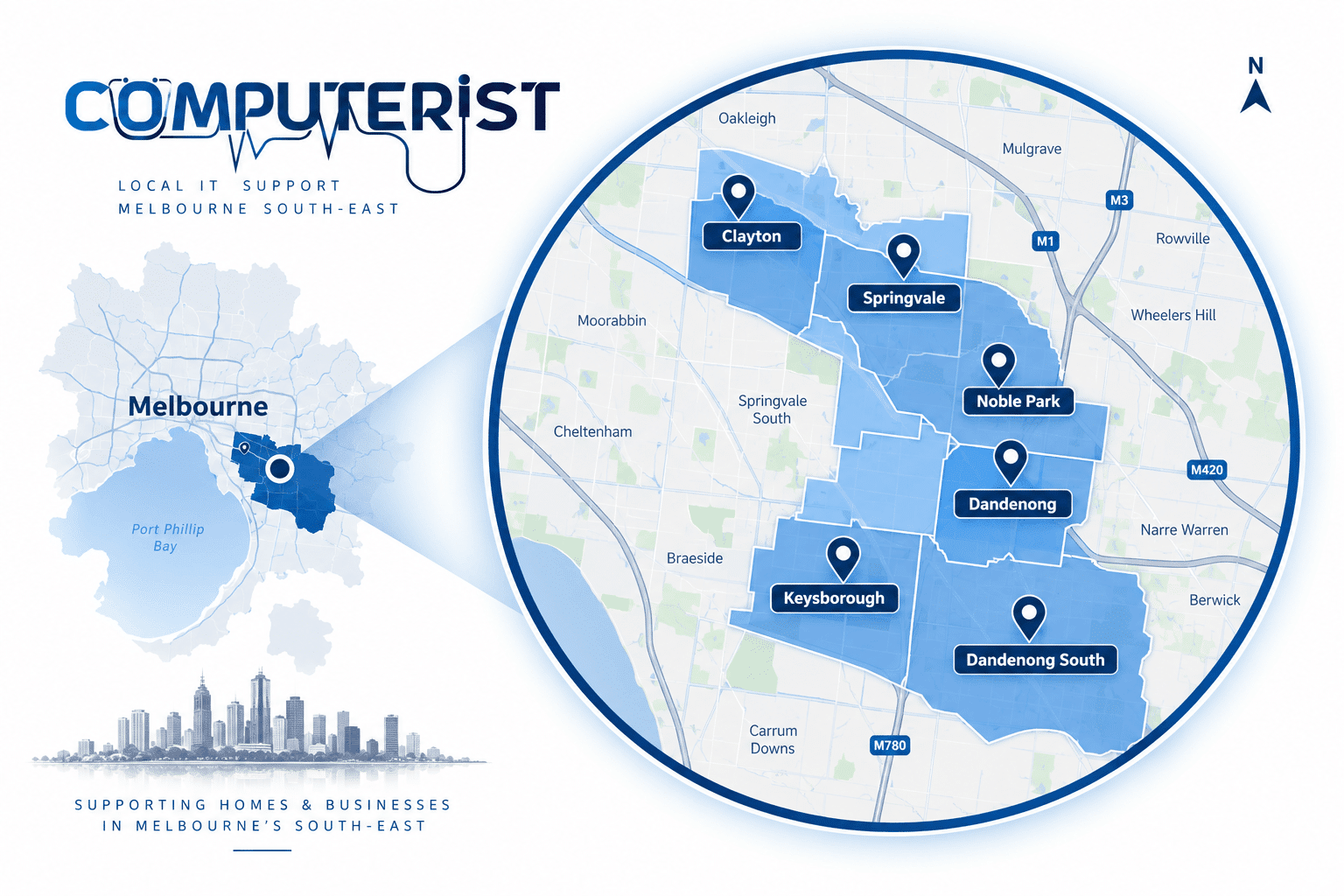
Computerist provides Computer & Hardware Upgrades across Melbourne’s South-East, including Noble Park, Springvale, Dandenong, Clayton, Keysborough & Dandenong South. We may also support surrounding south-eastern suburbs where the service requirement is suitable.

Need a Computer Upgrade?

Not sure whether your computer needs an upgrade or replacement? Computerist can assess your existing hardware, identify what’s limiting performance and explain which upgrades are worthwhile. We’ll help you understand what makes sense before you spend money on new hardware.

NO FIX, NO FEE*

We charge an hourly rate for the time spent working on your technology. If we’re unable to resolve the problem, you won’t be charged for the diagnostic or travel component.

*Some exclusions and conditions may apply. We’ll explain applicable charges before work begins.

Get Your Questions Answered

Often, yes. We first identify what’s limiting performance. Depending on the system, an SSD, RAM or other upgrade may provide a meaningful improvement.

For many older computers still using mechanical hard drives, an SSD can provide a substantial improvement in responsiveness. Compatibility and the condition of the existing drive need to be checked first.

It depends on the model. Some laptops allow storage and/or memory upgrades, while others have components that are integrated into the motherboard.

Yes. Desktop computers generally provide more upgrade options, depending on the motherboard, case, power supply and existing components.

Yes, if the computer supports additional or higher-capacity memory. We’ll check the specifications before recommending RAM.

Often, yes. We can assess the existing system and determine whether an SSD upgrade and data migration are appropriate.


Yes. We can assess the system and identify whether the graphics card, CPU, RAM, storage, cooling or another component is limiting performance.


Potentially. The most useful upgrade depends on your editing software, workflow and existing hardware. RAM, storage, CPU and GPU performance may all be relevant.

Yes, where the computer supports it. We need to consider physical space, power supply, motherboard, cooling and other components.

Yes. Depending on the computer, this may involve replacing the existing drive, adding a second drive or using external storage.

Not necessarily, but any significant storage work carries some risk. Important data should be backed up before an upgrade wherever possible

We’ll assess the existing system, your requirements and the likely cost of upgrading. If replacement makes more sense, we’ll tell you.

Yes. We can assess your existing computer and help determine what hardware is compatible and appropriate for your requirements.

Hardware availability can vary. Where appropriate, we can discuss suitable components and installation options.