Practical Cloud Services for Small and Growing Businesses
Cloud Services
Cloud Services That Fit the Way Your Business Works
Moving business systems to the cloud can improve accessibility, flexibility and collaboration, but the right setup depends on how your business actually operates. Computerist can help with cloud setup, migration, configuration, security, backup and ongoing support, while making sure your cloud environment works properly with your users, devices and other business systems.
Cloud technology has changed the way businesses operate.You no longer need every application, file and system sitting inside a server room to run a business.Email can live in the cloud.Documents can be accessed from anywhere.Employees can collaborate across locations.Applications can be delivered as cloud services.Infrastructure can be hosted remotely.And businesses can scale technology without necessarily buying more physical hardware.But moving to the cloud doesn’t automatically make IT simpler.Poorly planned cloud environments can become expensive, difficult to manage and unnecessarily complicated.Computerist provides practical Cloud Services for small and growing businesses across Melbourne’s south-east.We help businesses understand where cloud technology makes sense, plan migrations, configure cloud environments and support the technology after the move.
The goal isn’t to put everything in the cloud.
The goal is to put the right things in the right place.
Cloud computing essentially means using computing resources, applications, storage or infrastructure delivered through a network rather than relying entirely on equipment located at your premises.
Depending on your business, this could include:
Cloud applications
Cloud storage
Cloud email
Cloud identity
Cloud infrastructure
Cloud backup
Cloud collaboration
Virtual machines
Hosted applications
Cloud security services
Microsoft 365 is one example of cloud computing, but cloud services are much broader than Microsoft 365.
Computerist can help businesses understand where different cloud services fit into their technology environment. For official information about Microsoft cloud services, see Microsoft Azure
Cloud Services for Business
Businesses often move towards cloud technology for reasons such as:
Flexibility
Remote access
Scalability
Reduced reliance on local hardware
Easier collaboration
Business continuity
Access to modern applications
Supporting hybrid work
Simplifying infrastructure
But cloud adoption should be driven by a business requirement.
“Because everyone else is using the cloud” isn’t a strategy.
We start by understanding what your business actually needs.
Cloud Migration
Moving an existing IT environment to the cloud can involve considerably more than uploading files.
A migration may involve:
Applications
Users
Identity
Data
Email
Servers
Storage
Networks
Security
Backups
Devices
Business processes
Computerist can help businesses assess their existing environment and determine which systems are suitable for migration.
The migration can then be planned around:
What should move?
What shouldn’t move?
What needs to change first?
What happens during the transition?
How do we recover if something goes wrong?
Moving From On-Premises to the Cloud
Many businesses still operate systems that were designed around physical infrastructure.
That may include:
File servers
Application servers
Local storage
On-premises email
Traditional authentication
Local applications
Some of these workloads may benefit from moving to cloud services.
Others may not.
Cloud isn’t automatically better simply because it’s newer.
A proper assessment should consider:
Cost
Performance
Security
Availability
Compatibility
Data
Business requirements
Existing infrastructure
Recovery requirements
Computerist can help businesses evaluate the options before committing to a migration.
Hybrid Cloud
Not every business needs to choose between:
Everything on-premises
and
Everything in the cloud.
A hybrid environment combines elements of both.
For example, a business might have:
Microsoft 365
Cloud applications
Local servers
Local network storage
Cloud backup
On-premises business applications
Hybrid environments can make sense where certain systems need to remain local while others benefit from cloud services.
The challenge is making sure the different environments work together reliably and securely.
Cloud Strategy
Before moving workloads to the cloud, businesses should consider what they’re trying to achieve.
A practical cloud strategy can examine:
Current infrastructure
Applications
Data
Users
Security
Costs
Performance
Business continuity
Compliance requirements
Future growth
The result should be a roadmap rather than a collection of disconnected cloud subscriptions.
Cloud Assessment
If you’re considering moving to the cloud, the first step doesn’t necessarily involve purchasing anything.
It can begin with an assessment.
We can help you identify:
What you have
Servers, applications, data and services.
What you actually need
Business requirements rather than technical fashion.
What could move
Suitable workloads and services.
What should remain
Systems that may be better kept locally or handled differently.
What needs to change
Infrastructure, security, identity or processes.
What the migration could involve
Time, dependencies, risks and recovery considerations.
Cloud Infrastructure
Cloud infrastructure can provide computing resources without requiring the business to own and maintain all of the underlying physical hardware.
Depending on the platform, this may include:
Virtual machines
Storage
Networking
Databases
Application platforms
Backup
Security services
Computerist can help businesses understand infrastructure requirements and determine whether cloud-hosted infrastructure is appropriate.
Cloud Virtual Machines
Some applications traditionally run on physical servers but can be hosted within cloud-based virtual infrastructure.
Potential benefits can include:
Scalability
Remote accessibility
Flexible resource allocation
Reduced dependence on local hardware
Easier infrastructure expansion
But cloud-hosted virtual machines still require:
Security
Updates
Backups
Monitoring
Access control
Appropriate configuration
Moving a server into the cloud doesn’t eliminate the responsibility of managing the workload.
Cloud Storage
Businesses increasingly use cloud storage for:
Documents
Collaboration
File sharing
Backups
Archives
Application data
Cloud storage can make information accessible from multiple locations, but businesses should still consider:
Permissions
Data ownership
Retention
Security
Backup
Sharing
Recovery
Cloud storage is not automatically a complete backup strategy.
Cloud infrastructure can sometimes provide additional recovery options.
Depending on the environment, businesses may be able to recover:
Virtual machines
Applications
Data
Services
Infrastructure
Cloud-based disaster recovery can be particularly useful where a business needs to recover systems without relying entirely on the original physical infrastructure.
The appropriate design depends on:
RTO
RPO
Critical systems
Data
Budget
Infrastructure
Cloud Cost Management
Cloud services can be flexible.
They can also become expensive when poorly managed.
Costs can grow through:
Unused resources
Oversized virtual machines
Duplicate services
Unused storage
Uncontrolled subscriptions
Poorly configured workloads
Automatic scaling
Unmonitored consumption
Cloud cost management should therefore be part of the overall strategy.
Moving to the cloud shouldn’t mean receiving a larger bill every month without understanding why.
Computerist can help businesses identify the technical factors contributing to cloud costs and determine where optimisation may be appropriate.
Cloud vs On-Premises
The answer isn’t always obvious.
Requirement
Cloud may make sense
On-premises may make sense
Remote access
Often
Can require additional infrastructure
Scalability
Often flexible
Hardware may need expansion
Physical control
Less
Greater
Local processing
Depends
Often advantageous
Existing server investment
May not justify immediate migration
Existing infrastructure may still be useful
Specialist legacy application
Depends on compatibility
May remain more practical
Internet dependency
Important consideration
Potentially less for local workloads
Capital expenditure
Often reduced
Hardware investment required
Ongoing cloud costs
Subscription/usage based
Hardware + maintenance
There is no universal winner.
The right choice depends on the business.
When Cloud May Not Be the Right Answer
This is worth saying explicitly.
Cloud may not be ideal where:
A legacy application requires local infrastructure
Internet connectivity is unreliable
Workloads require specialised local hardware
Cloud costs are disproportionate
Data requirements make another architecture more appropriate
Existing infrastructure remains efficient and well supported
Good IT advice sometimes means telling a customer not to migrate.
Computerist’s role is to help you make an informed decision.
Cloud Migration Planning
A successful migration starts before anything is moved.
Planning can involve:
Discovery
What systems and data currently exist?
Dependency mapping
Which applications depend on which systems?
Prioritisation
What should move first?
Security
How will identities, access and data be protected?
Migration
How will data and workloads be transferred?
Testing
How will we confirm everything works?
Cutover
When will users move to the new environment?
Recovery
What happens if something goes wrong?
Minimising Business Disruption
A cloud migration should not unnecessarily bring your business to a standstill.
Depending on the project, migration can be planned around:
Staged deployment
Pilot users
Test environments
Data synchronisation
Scheduled cutovers
Communication
Rollback planning
The appropriate approach depends on the size and complexity of the environment.
Cloud Support After Migration
Moving to the cloud isn’t the end of the project.
After migration, businesses may still need help with:
Users
Access
Applications
Security
Performance
Storage
Costs
Backups
Configuration
Troubleshooting
Computerist can provide ongoing technical support for suitable cloud environments.
Cloud Services & Microsoft 365
Microsoft 365 may be one of the first cloud platforms a small business adopts.
But it isn’t the entire cloud strategy.
A business may also use:
Cloud accounting
CRM
Cloud backup
Cloud storage
Hosted applications
Cloud infrastructure
Computerist can help businesses understand how these services fit together.
Still heavily dependent on on-premises infrastructure
Microsoft 365 experience
Computerist has extensive hands-on experience supporting Microsoft 365 environments, users, endpoints and tenants.
That provides a strong foundation for businesses already moving towards cloud-based services.
Real-world infrastructure experience
Computerist’s practical experience includes working with: Routers Switches Firewalls Wireless access points Business networks Endpoint environments Microsoft 365 Network migrations Infrastructure deploymentsThis includes involvement in wireless access-point rollouts and business infrastructure environments.
We explain technology in plain English
You shouldn’t need to be an IT professional to understand what is happening to your network.We’ll explain:What’s wrong.What can be done.What it is likely to cost.Whether it’s worth doing.
Microsoft 365 experience
Computerist has substantial practical experience supporting Microsoft 365 environments, users, endpoints and tenants.That matters because identity and cloud services are now central components of many business environments.
Network experience
Network security depends on understanding the network itself.
Computerist has practical experience with business networks, routers, switches, firewalls and wireless infrastructure.
A secure network doesn’t help much if the computers connected to it are poorly maintained.
Computerist understands endpoint deployment, configuration, monitoring and troubleshooting
Practical rather than theatrical
We’re not interested in frightening business owners into buying technology they don’t need.
We’ll explain:
What’s at risk.
What you’re already doing well.
What’s missing.
What should be fixed first.
What can wait.
Practical advice
Sometimes the best solution is a repair.Sometimes it’s an upgrade.Sometimes replacement is the better financial decision.We’ll explain the options.
Documentation matters
A network should be understandable.
We place importance on documenting relevant technical information so that future troubleshooting, upgrades and changes are easier.
Clear explanations
You don’t need to understand what every network or hardware component does.We’ll explain what matters and what doesn’t.
No Fix, No Fee
Where applicable, Computerist operates a No Fix, No Fee approach.The exact conditions depend on the nature of the work, so we’ll explain them before proceeding.
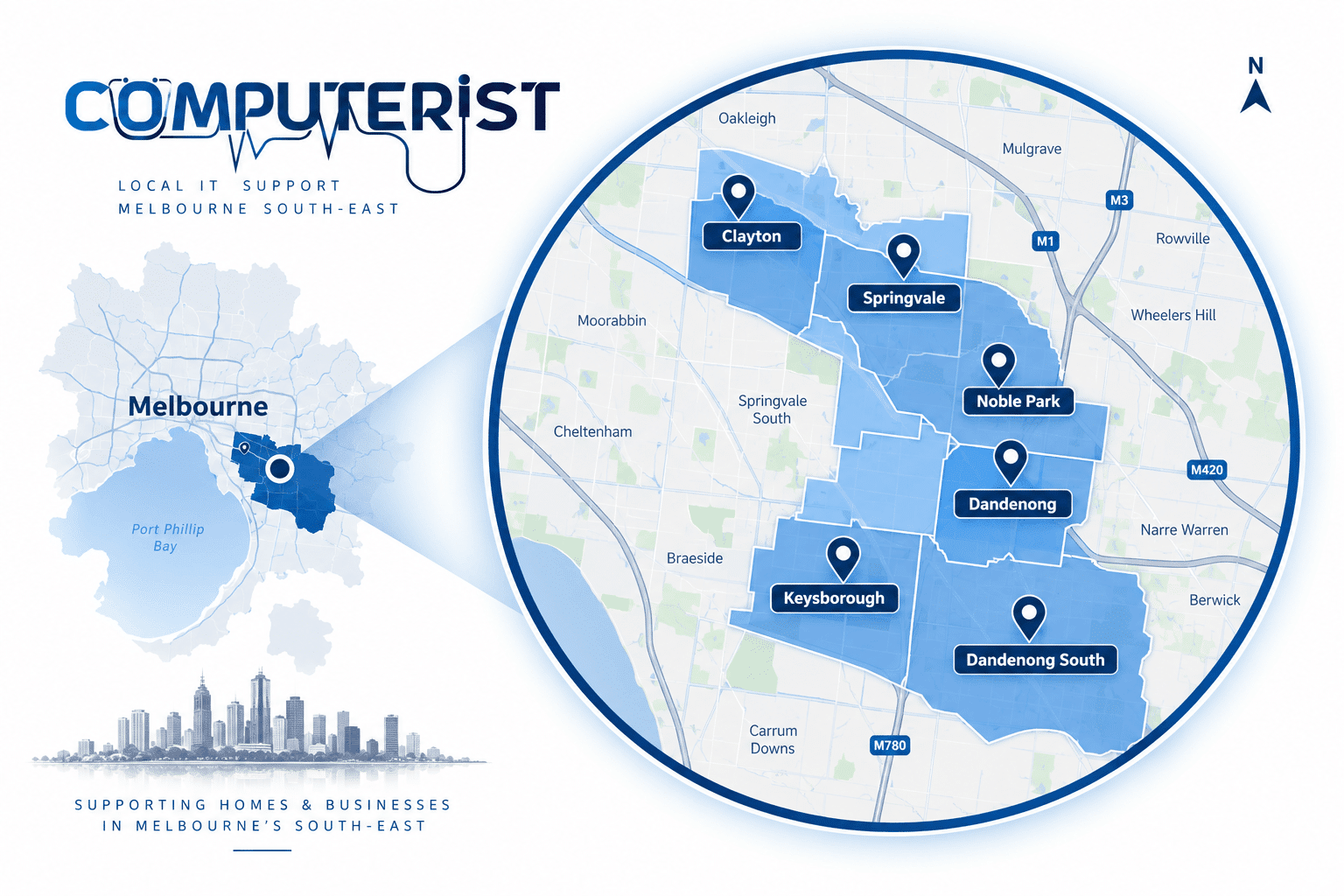
Cloud technology can give businesses flexibility, scalability and access to powerful services.But the objective isn’t to move everything simply because you can.Understand what you have.Identify what you need.Choose the right technology.Plan the migration.Protect the environment.Test the result.Support it afterwards.Computerist provides practical Cloud Services for small and growing businesses across Melbourne’s south-east..Noble Park · Springvale · Dandenong · Clayton · Keysborough · Dandenong South
Computerist IT Solutions
Cloud Services for Small Business Melbourne South-East
Whether you’re considering moving to the cloud, need help with an existing cloud environment, want to migrate away from an old server, or need to understand which cloud options make sense for your business, Computerist can help you identify the practical next steps.
We charge an hourly rate for the time spent working on your technology. If we’re unable to resolve the problem, you won’t be charged for the diagnostic or travel component.
*Some exclusions and conditions may apply. We’ll explain applicable charges before work begins.




 What Are Cloud Services?
 Cloud Services for Business
 Cloud Migration
 Moving From On-Premises to the Cloud
 Hybrid Cloud
 Cloud Strategy
 Cloud Assessment
 Cloud Virtual Machines
 Cloud Storage
 Cloud File Sharing & Collaboration
 Cloud Applications
 Cloud & Remote Work


 Cloud Security
 Cloud Backup
 Cloud Disaster Recovery

 Cloud vs On-Premises
 When Cloud May Not Be the Right Answer
 Minimising Business Disruption
 Cloud Support After Migration


 Cloud Services & Existing Servers
 Cloud & Business Continuity



 Fully cloud-based