Backup & Disaster Recovery in Melbourne’s South-East
When Something Goes Wrong, Can Your Business Recover?
Backup & Disaster Recovery
Backup & Disaster Recovery
A backup is only useful if it can actually be relied on when something goes wrong. Computerist can help businesses set up practical backup and disaster recovery solutions, protect important files and systems, monitor backups and test recovery so you know your data can be restored when you need it. From accidental deletion and hardware failure to ransomware or a major system outage, we help you prepare for the problems you hope never happen.
Computers fail.
Hard drives fail.
Servers fail.
People accidentally delete files.
Cloud accounts can be compromised.
Cyber attacks happen.
Offices can lose power.
Equipment can be damaged.
And sometimes, things simply go wrong.
The important question isn’t whether your business will ever experience an IT problem.It’s:What happens when it does?Computerist provides practical Backup & Disaster Recovery services for small and growing businesses across Melbourne’s south-east.We help businesses protect important data, review existing backup arrangements, improve recoverability and develop practical strategies for getting systems back into operation after a serious technology failure.
These two terms are often used together, but they aren’t quite the same thing.
Backup
A backup is a copy of your data, applications or system information that can be used to recover information after loss or damage.
Disaster Recovery
Disaster recovery is the broader process of restoring technology and business operations after a significant disruption.
That can involve:
Data
Computers
Servers
Applications
Microsoft 365
Networks
Configuration
User access
Business processes
In simple terms:
Backup answers:
“Do we have a copy?”
Disaster recovery asks:
“Can we actually get the business running again?”
You need both.
Why Business Backups Matter
Your business data may include:
Customer records
Financial information
Contracts
Invoices
Emails
Documents
Projects
Databases
Photos
Intellectual property
Staff information
Business applications
Losing that information can be expensive.
The impact isn’t limited to the cost of replacing a computer.
You may also face:
Lost productivity
Missed deadlines
Customer disruption
Lost revenue
Recovery costs
Reputational damage
Regulatory obligations
Business interruption
The Australian Cyber Security Centre recommends regular backups because they can help businesses recover information after data loss, damage, theft or cyber incidents.
What Can Cause Data Loss?
Data can disappear for many reasons.
Hardware failure
A storage device fails, and important information becomes inaccessible.
Accidental deletion
Someone deletes a file or folder they didn’t intend to remove.
Software failure
An application or operating-system problem damages or prevents access to information.
Malware
Malicious software can corrupt, delete or encrypt data.
Ransomware
Attackers can encrypt business files and demand payment for their release.
Account compromise
An attacker gains access to a cloud account and modifies or deletes information.
Theft
A laptop or other device containing business information is stolen.
Physical disaster
Fire, flood, power problems or other events can damage equipment.
Human error
Sometimes the cause is simply someone making a mistake.
A good backup strategy considers more than one failure scenario.
Ransomware & Business Backups
Ransomware is one of the clearest reasons businesses need resilient backups.
Ransomware can encrypt files and prevent a business from accessing important information. The ACSC recommends maintaining backups as part of ransomware resilience and advises ensuring backups are not themselves compromised.
Imagine your business has:
20 computers
A file server
Microsoft 365
Shared documents
Accounting data
and ransomware reaches your environment.
If your only “backup” is a drive permanently connected to the same network, the backup may be exposed to the same incident.
That’s why backup architecture matters.
The question isn’t simply:
“Do you have backups?”
It’s:
“Are your backups protected from the same failure that could destroy your production data?”
The Backup We Have Might Not Be Enough
One of the most dangerous assumptions in IT is:
“The backup software says successful, so we’re protected.”
A successful backup job doesn’t necessarily prove that your business can recover.
You also need to consider:
Can the data be restored?
How quickly can it be restored?
Is the backup complete?
Is it recent enough?
Are multiple systems backed up?
Are configuration settings protected?
Are backups protected from deletion?
Are credentials secure?
What happens if the primary backup system fails?
What happens during ransomware?
The ACSC specifically recommends testing restoration rather than waiting until an actual incident to discover whether recovery works.
Backup Testing
This is one of the most important parts of our approach.
A backup that has never been restored is an assumption.
A successfully tested restoration provides evidence.
Testing can involve restoring:
Individual files
Folders
Applications
System images
Virtual machines
Databases
Microsoft 365 data
Other critical information
The appropriate test depends on your environment.
The ACSC’s Essential Eight guidance states that restoration of data, applications and settings should be tested as part of disaster-recovery exercises, including at least annually at the relevant maturity levels.
What Should Your Business Back Up?
Not every organisation has the same requirements.
Depending on your environment, important information may include:
Documents
Databases
Accounting systems
Customer information
Email
Microsoft 365 data
SharePoint
OneDrive
Servers
Application data
Configuration
Virtual machines
Network devices
Critical business applications
The first step is therefore not:
“Which backup product should we buy?”
It is:
“What information would seriously hurt the business if we lost it?”
Business-Critical Data
Different data can have different levels of importance.
For example:
Critical
Information required to operate the business.
Important
Information that would cause significant disruption if lost.
Recoverable
Information that could be recreated or obtained elsewhere.
This distinction can influence:
Backup frequency
Retention
Recovery priority
Storage
Cost
Recovery objectives
Backup strategy should follow business priorities.
Not the other way around.
Recovery Point Objective — RPO
RPO stands for Recovery Point Objective.
It answers:
“How much data can we afford to lose?”
For example:
If your RPO is four hours, your recovery strategy needs to minimise the possibility of losing more than approximately four hours of data.
A business processing transactions throughout the day may have very different requirements from a business whose data changes only occasionally.
Recovery Time Objective — RTO
RTO stands for Recovery Time Objective.
It answers:
“How quickly do we need to be operational again?”
For example:
A business may decide that:
Email should be restored quickly.
Critical applications need priority.
Some historical files can wait.
Non-essential systems can be restored later.
RTO helps determine recovery priorities.
RPO + RTO = A More Useful Recovery Strategy
These two concepts help turn vague statements such as:
“We need good backups.”
into something measurable.
For example:
RPO: No more than four hours of critical data loss.
RTO: Critical systems restored within eight hours.
Those objectives can then influence the backup and recovery design.
Not every business needs the same numbers.
The correct targets depend on the cost of downtime and data loss.
Backup Frequency
A backup strategy should reflect how quickly your data changes and how much loss the business can tolerate.
Possible approaches include:
Continuous or near-continuous protection
Multiple backups per day
Daily backups
Weekly retention
Monthly retention
Long-term archival
There is no universal “best” frequency.
A business that processes hundreds of transactions every day has different requirements from one that changes a handful of documents each week.
Backup Retention
Backing up every day doesn’t answer the question:
“How far back can we recover?”
Retention determines how long previous backup versions remain available.
This can matter when:
A file is deleted, and nobody notices immediately.
Malware remains undetected.
A compromised account changes data.
Ransomware encrypts files over time.
An older version of a document is required.
Retention should be based on business requirements, not simply whatever the software’s default setting happens to be.
The 3-2-1 Principle
A commonly used backup concept is the 3-2-1 approach:
3
Keep multiple copies of important data.
2
Use different types of storage or media.
1
Keep at least one copy separate from the primary environment.
The exact implementation should reflect your business, technology and risk profile.
For modern environments, businesses may also consider immutable or otherwise protected backup copies and geographically separate recovery options.
The principle is simple:
Don’t put all your recovery eggs in one basket.
Offsite Backups
If every copy of your data is physically located in the same office, a physical disaster could affect all of them.
Offsite protection can help reduce that risk.
Depending on the environment, this could involve:
Cloud storage
Offsite replication
Secondary infrastructure
Secure external media
Another physical location
The ACSC gives examples of backup arrangements that include offsite copies and emphasises secure, resilient backup practices.
Cloud Backup
Cloud-based backup can provide businesses with another location for storing protected copies of important information.
Potential advantages include:
Offsite storage
Automation
Scalability
Remote access to recovery infrastructure
Reduced dependence on local hardware
But “it’s in the cloud” does not automatically mean:
It’s backed up.
Cloud services vary considerably in their native recovery capabilities and retention.
The actual backup design needs to be understood.
Microsoft 365 Backup Considerations
Cloud services change the way businesses think about backups.
Your data may live in:
Exchange Online
OneDrive
SharePoint
Teams
Microsoft 365 provides native retention and recovery capabilities, but businesses should still determine whether those capabilities meet their own recovery requirements.
Computerist can help you understand what protection you currently have and where additional backup considerations may be appropriate.
OneDrive Is Not Automatically Your Entire Backup Strategy
OneDrive synchronisation is useful.
But synchronisation and backup solve different problems.
If a user deletes a file and that deletion synchronises across devices, synchronisation doesn’t necessarily provide the same protection as an independent backup with appropriate retention.
Likewise, if an account is compromised, you need to consider what an attacker could access or modify.
Cloud synchronisation is useful.
It shouldn’t automatically be treated as a complete disaster-recovery strategy.
SharePoint & Teams Data
Businesses often assume that because information is stored in Microsoft 365, it is automatically protected against every possible form of data loss.
That’s too simplistic.
Businesses should understand:
What is stored
Who can access it
What native recovery exists
How long deleted information remains recoverable
What happens after an account compromise
Whether additional backup is required
Computerist can help businesses review these considerations.
Server Backup
Businesses with physical or virtual servers may have additional recovery requirements.
A server backup strategy may need to protect:
Operating system
Applications
Databases
Files
Configuration
Virtual machines
System state
Application dependencies
The objective isn’t merely to recover a folder.
In some situations, the business needs to recover the whole service.
Virtual Machine Backup
Virtualised environments can simplify some aspects of backup and recovery.
Depending on the platform, backup may involve:
Virtual machines
Snapshots
Application-aware backups
Configuration
Host infrastructure
Offsite copies
Snapshots can be useful operationally, but they should not automatically be treated as a substitute for a properly designed backup strategy.
Endpoint & Laptop Backup
Employees increasingly work from laptops.
That creates an important question:
What happens if an employee’s laptop is lost tomorrow?
A business may need to recover:
Documents
Desktop files
User data
Application configuration
Business information
Cloud synchronisation, endpoint backup and other protection mechanisms can be considered depending on the environment.
Backup Security
Your backup contains valuable information.
That makes it a target.
A secure backup strategy should consider:
Authentication
Access control
Encryption
Administrator privileges
MFA
Network separation
Immutability where appropriate
Retention
Monitoring
Deletion protection
The Essential Eight guidance specifically addresses protecting backups from modification and deletion by inappropriate accounts.
A backup that an attacker can simply delete is a much weaker recovery control.
Immutable Backups
An immutable backup is designed so that protected backup data cannot be modified or deleted during a defined retention period.
This can be particularly valuable when considering ransomware.
The exact implementation depends on the backup platform and storage architecture.
Computerist can help businesses understand whether immutable or otherwise protected backups are appropriate for their environment.
Backup Encryption
Backup data may contain the same sensitive information as the production environment.
Encryption can help protect that information if backup storage is compromised or accessed without authorisation.
Encryption should be considered alongside:
Key management
Access control
Recovery requirements
Backup platform
Offsite storage
Disaster Recovery Planning
Backup is only one part of disaster recovery.
A practical recovery plan should consider:
What happened?
Hardware failure?
Cyber attack?
Fire?
Flood?
Accidental deletion?
What systems are affected?
What needs to be restored first?
Where are the backups?
Who is responsible?
What dependencies exist?
How will users work while systems are being restored?
How do we know recovery is complete?
These questions turn backup into a real recovery strategy.
Disaster Recovery Isn’t Just an IT Problem
A major technology outage can affect:
Employees
Customers
Suppliers
Finance
Operations
Communication
Compliance
Management
IT can restore systems.
But the business needs to decide:
Which systems matter most?
How long can we operate without them?
What workaround exists?
Disaster recovery should therefore be aligned with business continuity.
Disaster Recovery Testing
A plan sitting in a document isn’t enough.
People need to know whether the plan works.
Testing can reveal:
Missing credentials
Unknown dependencies
Incorrect backup settings
Incomplete backups
Slow recovery
Missing documentation
Configuration problems
Unclear responsibilities
The ACSC recommends testing restoration as part of disaster-recovery exercises rather than waiting for a real incident.
Testing isn’t about proving everything is perfect.
It’s about discovering problems before the real disaster does.
What Happens If Your Primary Server Fails?
A sensible recovery plan might look something like:
Identify the failure
Determine whether the problem is hardware, software, storage or something else.
Protect the remaining environment
Prevent further damage.
Determine recovery priority
Identify the services that need to return first.
Select the recovery point
Choose an appropriate backup.
Restore
Recover the relevant system, application or data.
Validate
Confirm the restored service actually works.
Resume operations
Return users to the restored environment.
Investigate
Determine why the original failure occurred.
What Happens During a Ransomware Incident?
Ransomware recovery is different from ordinary hardware failure.
You need to consider:
Containment
Scope
Compromised devices
Compromised accounts
Backup integrity
Malware removal
Recovery order
Credentials
Security improvements
The ACSC advises checking that backups are free from ransomware before using them for recovery and recommends professional assistance if businesses suspect their backups may also be compromised.
Never assume that the newest backup is automatically the safest backup.
Don’t Build Your Recovery Plan Around Paying a Ransom
Paying a ransom doesn’t guarantee that data will be restored or that stolen information won’t be published.
The ACSC advises against paying ransomware demands.
A stronger strategy is:
Prevent where possible.
Detect quickly.
Contain the incident.
Recover from clean backups.
Improve the environment afterwards.
Backup & Disaster Recovery Assessment
If you’re unsure whether your existing backup strategy is actually adequate, Computerist can help review it.
We can consider areas such as:
What is being backed up?
How often?
Where?
For how long?
Who can access it?
Can backups be deleted?
Are copies offsite?
Are backups protected against ransomware?
Have restores been tested?
What systems are critical?
How quickly do they need to return?
The goal isn’t to sell you more storage.
It’s to determine whether your recovery strategy actually matches your business needs.
Common Backup Mistakes
“We have a USB drive.”
A single backup drive isn’t necessarily a complete business continuity strategy.
“Microsoft 365 is in the cloud.”
Cloud availability and independent backup/recovery are not necessarily the same thing.
“The backup software says successful.”
A successful job doesn’t prove the restore will work.
“We have RAID.”
RAID can improve availability, but it isn’t a backup.
“We have snapshots.”
Snapshots can be useful, but they aren’t automatically a substitute for independent backups.
“The backup is connected to the server.”
If ransomware can access the production environment and the backup using the same credentials or network path, both may be at risk.
“We’ve never needed to restore anything.”
That’s precisely why recovery testing matters.
RAID Is Not Backup
This deserves its own warning.
RAID can provide redundancy against certain hardware failures.
It does not protect against:
Accidental deletion
Ransomware
Corruption
Malicious activity
Fire
Theft
Many software failures
RAID helps keep systems available.
Backup helps recover data.
They solve different problems.
Backup & Disaster Recovery for Small Business
Small businesses don’t necessarily need an enormous enterprise disaster-recovery environment.
But they do need to understand:
What matters.
What can be lost.
How quickly recovery is required.
Where backups are stored.
Who can access them.
Whether recovery has been tested.
A sensible small-business strategy can often be considerably simpler than an enterprise architecture.
The important thing is that it is appropriate and actually works.
Backup & Disaster Recovery for Microsoft 365
If your business relies heavily on Microsoft 365, your recovery strategy should account for the services you use.
This may include:
Exchange Online
OneDrive
SharePoint
Teams
Microsoft Entra ID
User accounts
Business data
Computerist can help you understand the recovery capabilities available in your Microsoft 365 environment and identify where additional protection may be appropriate.
Computerist understands that backup doesn’t exist in isolation.
It connects with:
Microsoft 365
Windows
Endpoints
Servers
Networks
Cybersecurity
Cloud services
Business continuity
That broader understanding helps create a recovery strategy that reflects the actual environment.
Security matters
A backup that is easy for everyone to access may also be easier for an attacker to compromise.
We consider practical controls around:
Access
MFA
Administrator privileges
Separation
Encryption
Retention
Recovery
We focus on recoverability
The objective isn’t:
“Your backup software is running.”
The objective is:
“Your business has a realistic way to recover.”
We don’t sell fear
Disaster recovery can sound frightening.
Our job is to make it practical.
We’ll explain:
What could happen.
What you’re already protected against.
Where the gaps are.
What matters most.
What you should fix first.
Real-world infrastructure experience
Computerist’s practical experience includes working with:
Routers
Switches
Firewalls
Wireless access points
Business networks
Endpoint environments
Microsoft 365
Network migrations
Infrastructure deployments
This includes involvement in wireless access-point rollouts and business infrastructure environments.
We explain technology in plain English
You shouldn’t need to be an IT professional to understand what is happening to your network.We’ll explain:What’s wrong.What can be done.What it is likely to cost.Whether it’s worth doing.
Microsoft 365 experience
Computerist has substantial practical experience supporting Microsoft 365 environments, users, endpoints and tenants.
That matters because identity and cloud services are now central components of many business environments.
Network experience
Network security depends on understanding the network itself.
Computerist has practical experience with business networks, routers, switches, firewalls and wireless infrastructure.
A secure network doesn’t help much if the computers connected to it are poorly maintained.
Computerist understands endpoint deployment, configuration, monitoring and troubleshooting
Practical rather than theatrical
We’re not interested in frightening business owners into buying technology they don’t need.
We’ll explain:
What’s at risk.
What you’re already doing well.
What’s missing.
What should be fixed first.
What can wait.
Practical advice
Sometimes the best solution is a repair.Sometimes it’s an upgrade.Sometimes replacement is the better financial decision.We’ll explain the options.
Documentation matters
A network should be understandable.
We place importance on documenting relevant technical information so that future troubleshooting, upgrades and changes are easier.
Clear explanations
You don’t need to understand what every network or hardware component does.We’ll explain what matters and what doesn’t.
No Fix, No Fee
Where applicable, Computerist operates a No Fix, No Fee approach.The exact conditions depend on the nature of the work, so we’ll explain them before proceeding.
Local Backup & Disaster Recovery in Melbourne’s South-East
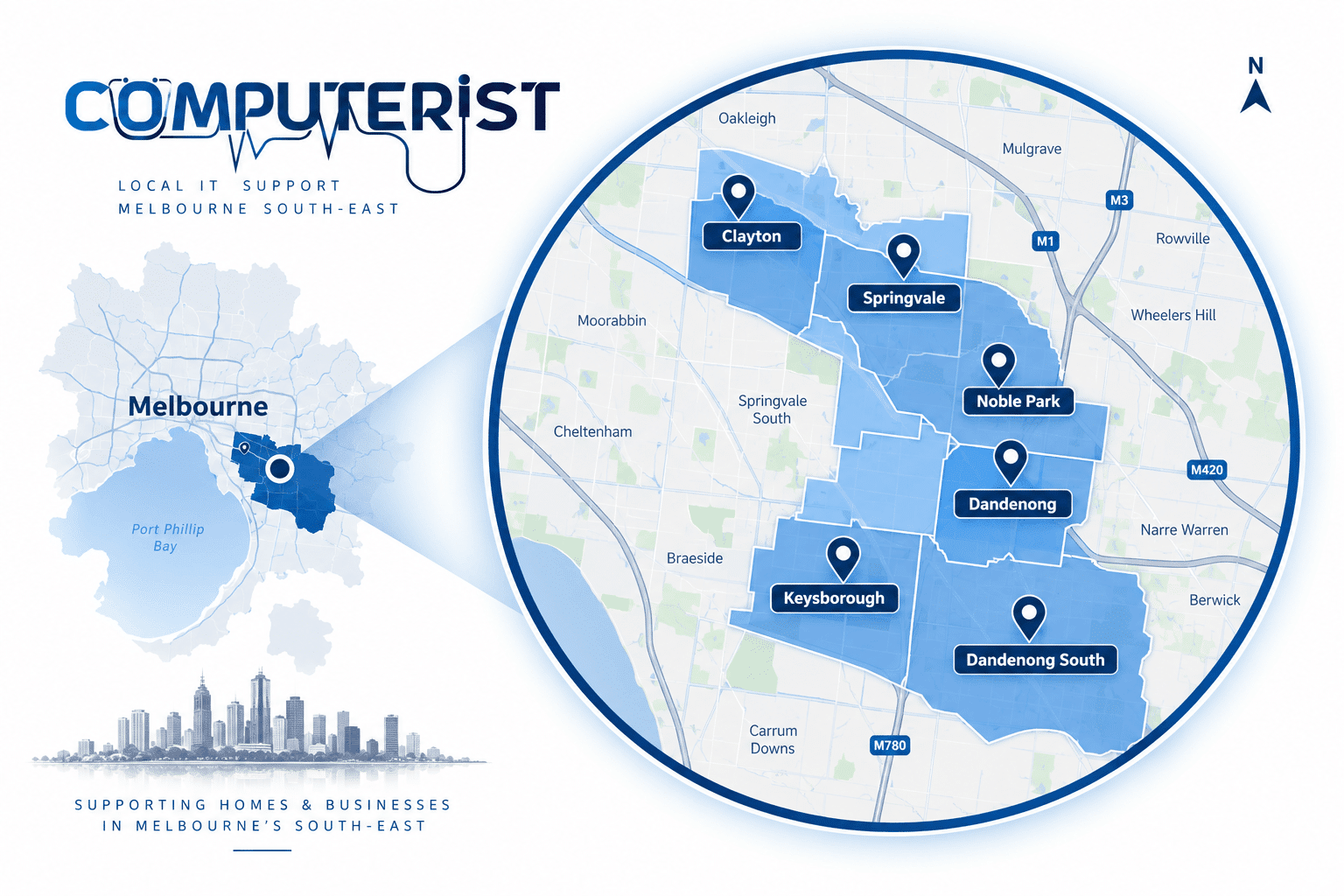
The worst time to discover your backup doesn’t work is after your business has lost its data.A good backup strategy should answer:What are we protecting?How often are we protecting it?Where are the copies?Are they secure?How long can we recover from?How quickly can we recover?Who is responsible?Has the recovery actually been tested?Computerist helps small and growing businesses across Melbourne’s south-east build practical backup and disaster-recovery strategies designed around the way their businesses actually operate.Noble Park · Springvale · Dandenong · Clayton · Keysborough · Dandenong South
Whether you need to review your existing backups, protect Microsoft 365 data, improve ransomware resilience, plan for a server failure or understand whether your business could actually recover after a serious incident, Computerist can help you identify the practical next steps.
We charge an hourly rate for the time spent working on your technology. If we’re unable to resolve the problem, you won’t be charged for the diagnostic or travel component.
*Some exclusions and conditions may apply. We’ll explain applicable charges before work begins.





 Data
Data


 Ransomware & Business Backups

 Backup Testing
 What Should Your Business Back Up?
 Business-Critical Data

 Recovery Time Objective — RTO

 Backup Frequency
 Backup Retention
 The 3-2-1 Principle

 Cloud Backup
 Microsoft 365 Backup Considerations
 OneDrive Is Not Automatically Your Entire Backup Strategy

 Server Backup
 Virtual Machine Backup
 Endpoint & Laptop Backup


 Disaster Recovery Isn’t Just an IT Problem
 Disaster Recovery Testing
 What Happens If Your Primary Server Fails?

 RAID Is Not Backup
 Backup & Disaster Recovery for Small Business

 Backup & Disaster Recovery for Servers
 What Happens When You Contact Computerist?






 Backup & Disaster Recovery